Main Front Page
Some Background Info.
Providing Power
Making It Work
Other Folks in Other Places
The battery portables collection
The Boatanchors Collection
Vintage Test Gear
Last updated 7th October 2008
The Murphy B40 Series of Naval Communications Receivers
Background History 1 - Murphy Radio Ltd.
Murphy Radio of Welwyn Garden City, Hertfordshire, England, was mainly known, at least to the British public, as a volume manufacturer of home radio and televisions. For further information on their civilian activity, the reader is directed to www.murphy-radio.co.uk as being an authoritative site on their activity in that field. The company was founded sometime around 1929 by Frank Murphy and E.J. Power. Murphy, who left the company in 1937, was described by his senior operations manager, Robert Williams, as eccentric and always having a pipe in his mouth - borne out by the photo perhaps?
The company began with less than 10 employees but, at its height of war production, this rose to more than 2000. Developing expertise in the area of military communications, they designed and built Wireless Set Number 38 and others. The B40 sets, in production from around 1949 to the mid-sixties, would have benefitted from this experience.
 E.J. Power, c.1938
  Frank Murphy, c.1935
Background History 2 - The B40 Series
The B40 family of receivers were known in the Royal Navy as 'Admiralty Pattern 57140x'.
There were four variants manufactured this accounted for the last digit of the pattern number being 1, 2, 3, or 4. In other markets (notably the Royal Australian Navy) these were known as Murphy B40A, B, C, or D. There are 2 very similar receivers that look almost identical, and they are the same design but have a different frequency coverage. The B41 covers LF frequencies. The other model is called the 62B and is a general coverage LF and HF version. Both these are not as common as the B40. The B40 family itself is a rare enough beast these days and there is little historical information available on the Internet.
As I have recently acquired a late model B40D (or Pattern 571404, as its plate calls it) I will be concentrating on that model, However, this was the FSK-mode development of the earlier variants and represents, possibly, the final stage of that line of receivers. I am grateful to Ray Robinson of the Speech, Hearing and Language Research Centre, Macquarie University, Sydney, Australia, for permission to reproduce some of his earlier work and photos.
A Brief B40 Operator's Manual may be downloaded HERE (24 pages, 430Kb, LizardTech DjVu format)
The Official B40 Workshop Manual (Admiralty BR-1617) may be downloaded HERE (448 pages, 22Mb, pdf format)
Overview
The Navy's standard issue radio receiver, the B40, could be considered a work of art. Its striking pale green front panel is made of thick cast aluminium, with an enormous black paddle on the right to select one of the five wavebands it tuned through. Five tuning scales are arranged one above the other in a semi-circular 'bulge' that rises from the large tuning knob (flywheel driven for easy band cruising) at the bottom all the way to the top of the set, looking vaguely like the glass-fronted stairwells popular in up-market 1930's mansions around the Welwyn area. Each tuning scale is illuminated upon selection and there is a panel-light dimming rheostat on the back of the set.
Band changes are performed by a huge rotating drum that contains all the coils for the various wavebands. The wiring for each coil is brought out to contacts arranged around the edge of the drum, so that the coils for the selected band make contact against a set of fixed spring-loaded plungers and so be connected into the circuits.
The set is a general communications receiver of the single-conversion superheterodyne type. It has two RF stages and three IF stages with a continuous frequency range from 600 kHz to 30.2 MHz. It has a built in monitor speaker although extension speakers, headphones and line outputs may all be connected. It weighs 100 pounds (according to the plate, although it seems much heavier!) and it will work on 115 or 240 volts. The sensitivity is claimed to be 2 µv on CW and 4µv on AM for a 20 dB S/N.
Designed for the Royal Navy, it had to be, like all military equipment, strong and reliable, sensitive and easy to use. Being a ship-board set, weight was not a factor in its design and its heaviness (despite not being particularly bulky at 18" high and 13" wide) reflects the requirement to stay in tune when the big guns were thundering.
PERFORMANCE
The reception quality of the B40D can surprise. Despite being a single conversion design, it performs well against other military sets, such as the Racal RA17L, and easily outperforms its predecessor, the Marconi CR100 (Admiralty Set B28). The Murphy is a good performer, very sensitive, easy to tune, and easy to find the correct frequency by reading the linear scale, although it does suffer from low channel separation (even with the Anti-Cross Mod at maximum) - for example, calibrating to the WWV signal at 10MHz is difficult due to interference from broadcast stations on the band nearby. However, the controls all feel very solid and give the impression of doing exactly what they say they will. I do miss an S-meter on the Murphy, and a variable BFO for those occasional SSB forays, but that’s all.
A Word about FSK - Frequency-Shift Keying
Like FM, frequency-shift keying (FSK) shifts the carrier frequency of the transmitter. Unlike FM, however, FSK shifts the frequency between just two separate, fixed points. The higher frequency is called the mark frequency while the lower of the two frequencies is called the space frequency. (By contrast, an FM signal can swing to any frequency within its deviation range.)
FSK was originally developed to send text via radio-teleprinter devices. The shifting of the carrier between the mark and space was used to generate characters in the Baudot code, which can be thought of as a more elaborate version of the Morse code. At the receiver, the Baudot signals were used to produce printed text on printers and, later, video screens.
FSK is the fastest way to send text by radio, and the error-correcting modes (made possible by the advance and introduction of microprocessor technology) offer high accuracy and reliability. The frequency space occupied depends on the amount of shifting, but typical FSK signals occupy less than 1.5 kHz of space.

CONTROLS
(see the annotated picture)
- MONITOR SPEAKER
- AUTO-GAIN CONTROL (AGC) on/off switch
- NOISE LIMITER on/off switch
- NOISE LIMITER ADJUST control – to clip any peaks greater than the desired signal
- BANDWIDTH control, which has 3 positions of 8 kcs, 3 kcs and 1 kc (which is a crystal filter) The B40A has a 200 cps filter instead of a crystal filter.
- SYSTEM MODE switch. The first position switches in a CAL oscillator so that the scale can be set accurately. The top of the dial column can be opened and the scale set by moving the pointer. The next position is the R/T position, which is used for normal voice signals. The next is TUNE used to accurately tune in a station by listening to the heterodyne. Usually, the next 2 positions are called HIGH and LOW and have a different beat note for CW. However, the 'D' variant and has 4 positions - these are FSK NARROW/CW high & low, followed by FSK WIDE high & low. Next to this switch is a small knob for the AF GAIN(6a)
- LOUDSPEAKER on/off switch to silence the speaker for phones or external line connection. There is also an on/off switch on the back of the receiver to terminate the line in 600 ohms when it is not in use.
- MAINS (power) on/off switch with the mains plug below that – many Murphy’s, however, like my B40D, have this plug removed and blanked off. The cable entry is then to the rear.
- DOOR concealing the DIAL POINTER ADJUSTMENT on the DISPLAY COLUMN (9a). This has a different scale for each band, and each has a light behind it to show the band in use. The band scale is very clear and easy to use. It has little dots on some of the graduations, that match the crystal calibrator.
- LOGGING SCALE
- MAIN TUNING knob. It is large, with a flywheel and smooth to tune. It has a LOCKING LEVER (11a) next to it.
- NAME PLATE reading "Admiralty Pattern 571404, Receiver B40, Serial No.25194YK, Weight = 100lbs, Murphy Radio"
- DOOR concealing the CRYSTAL SOCKET and lamp. If you want to crystal lock the receiver to a fixed frequency, you can plug in a crystal of the desired receive frequency (less 500 kcs).
- CRYSTAL off/on switch. It selects this crystal instead of the oscillator coil and turns on the light behind the door. You can then tune the receiver to that frequency, and the receiver is now crystal locked. The 'D' variant with FSK mode has an OSCILLATOR TRIM (14a) control and scale just under this knob.
- ANTI-CROSS MODULATION control which changes the grid bias of the first RF amplifier. This changes the working characteristics of the amplifier to reduce cross modulation from any strong adjacent signal. Normally the control is fully clockwise.
- BAND SELECTOR switch. The bands are; Band 1: 0.64-1.65mcs, Band 2: 1.57-4.1mcs, Band 3: 3.9-10mcs, Band 4: 9.5-18.5mcs, Band 5: 17.6-30.5mcs. A small window shows the band in use, as well as the lights behind the scale.
- RF GAIN control
- Below this are 2 jacks for headphones and an earthing screw.
On the back are several switches and sockets. There is an audio output plug and line terminating switch, IF sockets antannae sockets and the panel lamp rheostat.
DESIGN
The first and second RF amplifiers use a CV327 and a CV303, which feed a CV302 mixer and CV327 oscillator. The IF amplifiers use three CV303 valves and the AGC and detector use a CV140 valve. The noise limiter also uses a CV140. The BFO is a CV303. The AF amplifiers are a CV303 and a CV304 with a CV346 rectifier and a CV287 regulator, for the oscillator power supply.
The schematic for the basic B40 covers three pages and is here as jpegs: (Warning! big files!)
B40_schematic page 1 B40_schematic page 2 B40_schematic page 3
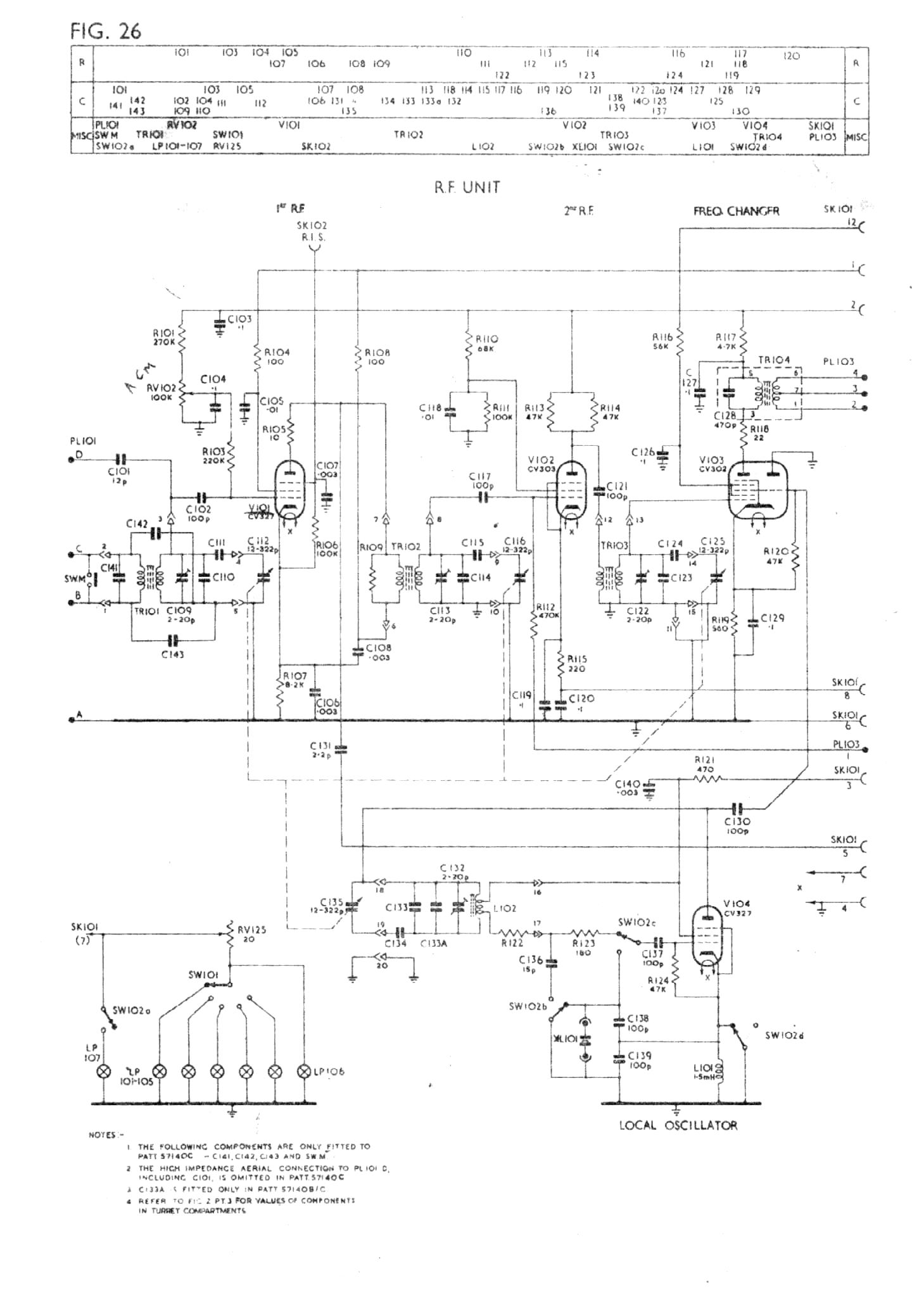
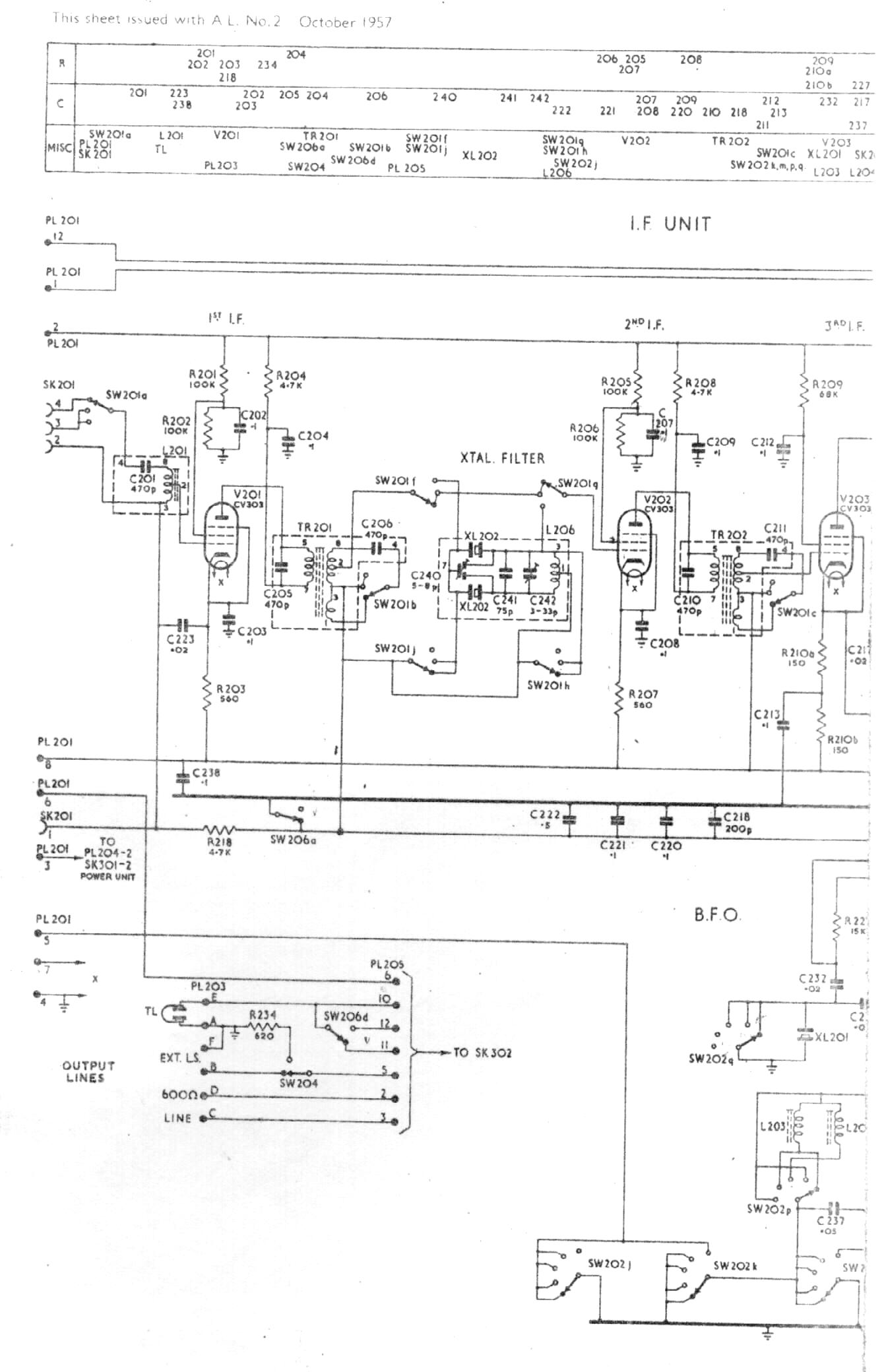
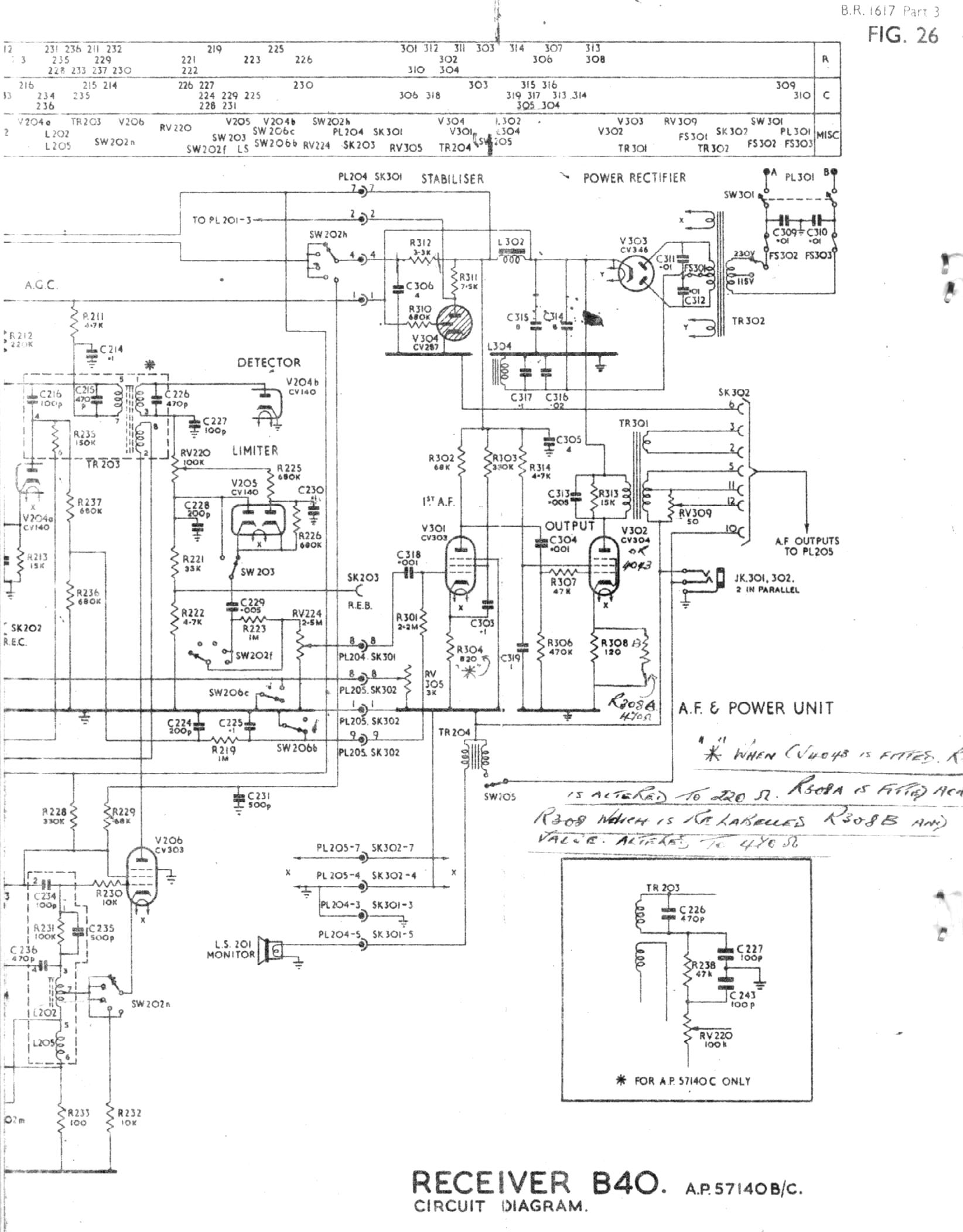
The mechanical design is very robust. It has a cast aluminium chassis for the power supply and audio amplifier which can be removed easily. Unscrew 2 screws at the back, remove the volume control knob, unplug 2 multi-pin plugs, and pull it out by the handle (visible in the interior photograph at the lower back, just above the fuses - the 2 screws are below the fuses). The U shaped cast chassis has all the heavy transformers and chokes on it. The valves in the audio section and the interconnecting plugs can be reached through a hole in the left hand side of the receiver (visible in the photograph).
Above the audio section is the IF strip, which is angled so that the undersides of the valves can be accessed (also visible in the photograph - top left) and at the front is the small speaker. The valves on this model are mainly the Loctal type. In the centre at the top is the tuning capacitor, and on the top right is the RF strip, also angled for access to the underside of the valves.
Beneath the centrally located tuning capacitor (and toward the right hand side), is the large band change turret (the back can be seen in the photograph). It rotates by use of the band switch knob, and positions a new set of coils for each band. The coils are mounted on cast alloy bases and are individually removable.
The case is removed by unscrewing the 2 screws at the front top, and pulling the case back. There is a rail fitted inside above the IF transformers to prevent the case from damaging the tops of the IF transformers.
The B40 receivers have two different types of connectors fitted to them.The mains connector (when it is left in place!) is only a 2 pin socket, and the mating plug is often hard to find. Likewise, the Plessey Mk.4 multi-pole plugs are hard to find. One must always make a reasonable asessment of any percieved loss of value caused by modifications.

CONCLUSION
The B40 is a nice looking, easy to use, sensitive communications receiver. It is easy to work on, uses parts that are readily available (for now), apart from some valves and the connectors. It is a nice receiver to own, providing you have a strong enough table. It is certainly a striking addition to any 'boatanchor' collection, being a rarity from the days of the British Commonwealth.